
The Lutheran Seminary: A Bicentennial
by Diana Loski
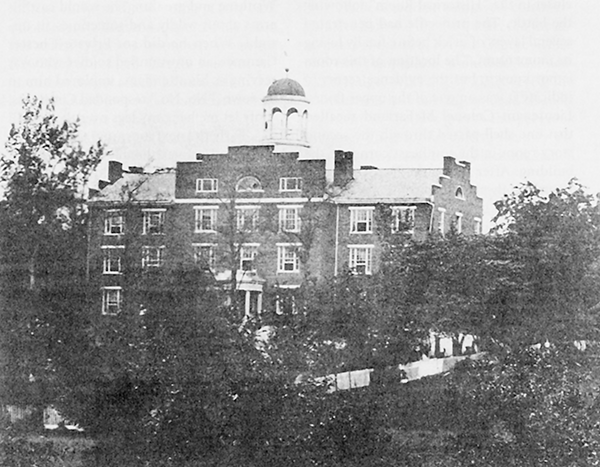
The Lutheran Seminary, 1863
(Adams County Historical Society)
The year 2026 is a celebratory year, largely due to the semi-quincentennial commemoration of the birth of the United States with the Declaration of Independence. There is another milestone anniversary closer to home with the bicentennial of Gettysburg’s Lutheran Theological Seminary.
Gettysburg’s Seminary Ridge gets its name from the Lutheran Theological Seminary that has been perched upon the rise long before the Battle of Gettysburg took place. The seminary is actually the first Lutheran seminary to be established in North America. Gettysburg was chosen for the site of this historic institution, due mainly to the efforts of Lutheran minister and abolitionist Samuel Simon Schmucker. Dr. Schmucker, with his father, managed to convince the Lutheran leadership that Gettysburg was the ideal location.1
Samuel Simon Schmucker, born in 1799 in Maryland, was the son of German immigrant John Schmucker, already a renowned leader of the Lutheran fellowship in the new nation. The younger Schmucker, classically trained and educated in Philadelphia, decided to follow in his father’s footsteps. A trip to the wilds of Kentucky with his brother, Daniel, was an eye-opening experience. The largely unsettled frontier of the fairly new state (Kentucky achieved statehood in 1792) convinced Schmucker that the backwoods populace suffered with a lack of both temporal and spiritual education. Shortly after his return to northern Virginia, where he had served his first congregation, Schmucker and his father served on a committee for the foundation of a seminary for the Lutheran faith.2
Pennsylvania, Maryland, and Virginia were all in the contest for the site. Schmucker was particularly struck with the small town of Gettysburg. Situated ideally in the fertile valley surrounded by hills and mountains, in close proximity to Maryland and northern Virginia, and with a sizable German population within a reasonable distance, Gettysburg was officially chosen on August 1, 1826.3
After the purchase of the needed lands, and buildings either erected or planned, by September of 1826 the first seminary students began attending classes.
Dr. Schmucker, the first President of the Seminary, resided in a stately home on the premises of the seminary. He raised his children, managed the seminary, and published books and pamphlets from there.
Dr. Schmucker established another, secular, institute of higher learning in Gettysburg. In 1832, Pennsylvania College was founded just a few miles northeast of the seminary. Both institutions continue today. Pennsylvania College is now known as Gettysburg College.
Also in 1832, the seminary’s best-known edifice was built and dedicated. Known then as Old Dorm, it is now called Schmucker Hall, recognized by its iconic green-domed cupola.
The Lutheran Theological Seminary found itself surrounded by the Civil War’s greatest engagement during the Battle of Gettysburg, notably on the first day of battle, July 1, 1863.
Brigadier General John Buford, commander of a division of Union cavalry, realized that the advancing Confederate columns would soon meet with the Union ones at Gettysburg. In an attempt to stall the men in gray and protect the town, General Buford deployed his men west of town on the Chambersburg Pike. Fighting ensued that day, leading from Herr’s Ridge to McPherson’s Ridge – and eventually to Seminary Ridge.
Major General John Reynolds, who was the commander of the Federal First Corps and a wing commander at Gettysburg, met John Buford at Schmucker Hall (Old Dorm). When Buford saw Reynolds approaching, he sighed with relief and said, “Now we can hold the place.”4
The Union forces did indeed prevail at Gettysburg, although the Confederates held the town – and Seminary Ridge – for the duration of the battle. Myriad wounded and dying lay within the seminary buildings and without on the surrounding lands. As the day ended and the two armies swept through the town, one soldier remembered that “only the dead and dying remained on Seminary Ridge.” For many days after the fight, the Lutheran Seminary served as a hospital for the many wounded left behind.5
Dr. Schmucker, who was in danger of capture during the battle, fled the seminary. To this day, no one knows where he went, and he was circumspect upon his return. In 1864, he retired, and passed away in 1873.
Before and during the Civil War, the seminary leaders and students worshipped at the Christ Lutheran Church in town. The church, like the seminary, also housed wounded and dying during and after the battle.
In spite of being front and center during the terrible fight, the seminary has survived. It remains the oldest Lutheran Seminary in North America, and continues to contribute to the Gettysburg community as well as the rest of the nation. In 1913, the seminary’s Schmucker Hall doubled as a hotel for the dignitaries attending Gettysburg’s 50th Anniversary Reunion.6
In the 1940s, during World War II, the current chapel was built at the Seminary. In 2017 the seminary merged with the Lutheran Seminary of Philadelphia.7
In addition to the many Civil War era and early 20th century buildings, the Lutheran Theological Seminary also contains the only non-Civil War, non-U.S. military statue on the Gettysburg battlefield. It is a memorial to the seminary’s namesake, Martin Luther, who fought a war of his own nearly a half-millennium ago.
Sources: Longacre, Edward. General John Buford: A Military Biography. Conshohoken, PA: Combined Publishing, 1995. Pfanz, Harry W. Gettysburg: The First Day. Chapel Hill & London: The University of North Carolina Press, 2001. Schmucker, Samuel Simon Church Records, Lutheran Theological Seminary. Copy, Adams County Historical Society (hereafter ACHS). The United Lutheran Seminary/Gettysburg Campus website: www.unitedlutheranseminary.edu.
End Notes:
1. Schmucker Church Records, copy ACHS.
2. Ibid.
3. Ibid.
4. Longacre, p. 192.
5. Pfanz, p. 311.
6. Unitedlutheranseminary.edu.
7. Ibid.
