
A Bucktail to the Rescue
by Diana Loski
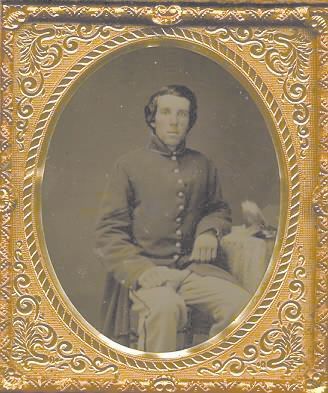
A Pennsylvania Bucktail soldier, likely from the 42nd Pennsylvania Infantry.
Photo is from the Library of Congress.
In mid-December 1862, just after the Battle of Fredericksburg, the Pennsylvania Governor Andrew Curtin made a hurried trip to Washington to dispatch aid for the wounded soldiers of his state. There were countless wounded and killed from the recent and ill-advised frontal assault on Marye's Heights. The Union suffered terrible casualties, and the Southerners, well-entrenched, had suffered far fewer losses. After a one-on-one interview with President Lincoln, where the pair made plans for the many wounded of the late battle, Curtin began the walk back to his hotel. On the way, a woman approached him. She was also from Pennsylvania, and carried a look of obvious distress.
She explained that her son had been seriously wounded at Fredericksburg, and she had attempted many times, in vain, to get to northern Virginia. She asked for his help to secure passage to her son.
The governor told her that all Pennsylvania soldiers wounded in the battle were coming to Washington, and he implored her to stay in the city. Learning that she had no place to stay, he wrote a quick letter of introduction, told her about a nearby boarding house where he knew the proprietor, and hailed a cab for her. Paying the driver a double fare, he gave directions and sent the tearful mother on her way.
As soon as he closed the carriage door, Curtin saw two colleagues from Pennsylvania. He greeted them and began walking with them down the street, still in view of the carriage. Suddenly the same cab pulled up beside them. The driver, using coarse language, attempted to pull the woman from his carriage.
Governor Curtin, shocked at the driver’s behavior, rushed to the woman’s aid, arguing with the surly driver that he had paid him well and ordered him to take the passenger to the boarding house. The driver insisted that he had received no fare, and told the woman to leave his carriage or he would throw her out.
As Curtin continued with the argument, he felt a tap on his shoulder. He turned to see a young man dressed in Union blue. On his kepi was a buck’s tail, the emblem of the 42nd Pennsylvania Regiment, a unit widely renowned for its fighting prowess. The young man saluted him.
“Governor,” he asked, “can I be of any service to you? I belong to the Bucktails, and I come from McKean County. I saw you were having some trouble…if you have no objection, I’d like to thrash that brute.”
Curtin looked closely at the callow young soldier and then at the powerfully built cab driver. “Do you think you can do it?” he asked.
The soldier nodded.
“Then get at him.”
The soldier politely asked the governor to hold his weapon while he fought, which Curtin obliged. The Bucktail then introduced his fist into the driver’s jaw. The pair fought for a full five minutes, drawing a crowd that December night on the muddy, dank streets of Washington. The fight ended with the driver moaning in the gutter, and the soldier retrieving his rifle from the astonished governor.
“Is there anything else I can do?” the soldier asked.
“Yes,” Governor Curtin replied. “Jump on the box and take that poor woman to her boarding house.”
With a military salute, the Bucktail did so, and the bruised, would-be cheat of a cab driver at last followed the directions given to him. Curtin then continued the walk to his hotel, accompanied by his two colleagues, never prouder than at that moment of his state and those who wore the blue.
The 42nd Pennsylvania Regiment fought with distinction at the Battle of Gettysburg the following summer. They, much like the Union soldiers at Fredericksburg, would suffer significant casualties, but this time it would be defending their home state. The fate of the young Bucktail who came to the woman's rescue in Washington cannot be ascertained.
Governor Curtin, after the pleas of Gettysburg civilian and lawyer David Wills, granted permission, and state funds, for the creation of the first National Cemetery -- that would be located on Cemetery Hill in Gettysburg.
Governor Curtin never forgot the stalwart obedience of the young Bucktail that night in Washington, helping a grieving mother against a nefarious cab driver, and never knowing after that December night what became of him.
From the book Andrew Gregg Curtin: His Life and Service, by William Henry Egle. Cambridge, MA: Wentworth Press, 1916, pp. 390-392.

